How to get a sofa out of a flat
A sofa that came in flat-packed or through a wider door can be a real puzzle on the way out. Measure first, strip it down, then tackle the doorway, the stairwell or the lift in the right order.
Key points
- Measure the sofa's height, depth and diagonal, then the narrowest door, turn and stairwell on the route out.
- Take off the cushions, legs and any back sections before you lift anything.
- Most sofas go through a doorway on their end or tilted on their back, arms first, not flat and upright.
- Stairwells and lifts each have their own limits, and dismantling is sometimes the only way through.
- A two-person crew with the right kit is the safe answer when the route is tight or the sofa is heavy.
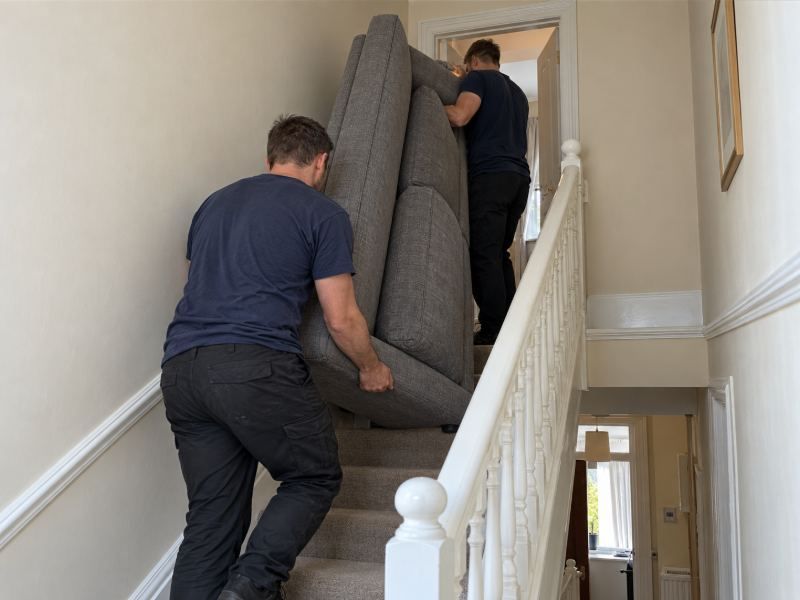
How to get a sofa out of a flat: measure before you lift
The first step in how to get a sofa out of a flat is a tape measure, not a strong friend. Measure the sofa's height from the floor to the top of the back, its depth from the front of the seat to the back, and its length arm to arm. Then measure the diagonal depth, the straight line from the top of the back to the front of the seat, because that is the dimension that decides whether it can tilt through a gap.
Now walk the route out and measure every pinch point. The door of the room, the hallway, the front door of the flat, any turn in the corridor, the stairwell width and the headroom at each landing, and the lift door and interior if there is one. Write the numbers down. The narrowest point on the route is your limit, and it is usually a door frame or a turn, not the straight run.
If the sofa's diagonal depth is smaller than the width of the narrowest door, it will tilt through. If its height is smaller than the door width, it will go through on its end. If neither works, you will be removing parts or dismantling, and it is better to know that now than halfway down a stairwell.
Strip it down: cushions, legs and anything that unscrews
Take every loose cushion off and move them out of the way. They add bulk and get in the way of hands. Then turn the sofa over and look at the legs. Most screw straight out or come off with a single bolt each, and removing them can take a surprising amount off the height. Bag the fixings and tape the bag to the frame so they do not get lost.
Look for anything else that comes apart. Some sofas have backs or arms that unbolt from the base, modular and corner sofas split into sections at the joins, and sofa beds have a metal mechanism that can be lifted out once a few bolts are undone. A recliner may have a motor and a mechanism that are heavier than the rest of the sofa put together. Every part you remove makes the lift lighter and the sofa smaller.
Wrap the frame in old blankets or dust sheets and tape them on. This protects the walls and the door frames of the flat and the communal areas as much as the sofa, and you will be glad of it when a corner catches a painted wall.
Not sure it will fit through the door?
Email a photo of the sofa and a line about the floor, the stairs and the lift. We will tell you how we would get it out and give you a fixed price for doing it.
Tilting and turning through doorways
A sofa almost never goes through a door the way it sits in the room. The standard move is to stand it on its end, arm down, and walk it through with the seat facing the door frame, then tilt the top through as the base clears. One person steers the top, the other takes the weight at the bottom and watches the base against the frame.
Where the door is narrower still, lay the sofa on its back with the seat facing the gap and curl it through, pivoting around the frame so the arms pass one at a time. This is where the diagonal measurement earns its keep. Go slowly, stop if anything catches, and never force a frame that is held on by staples and glue. Take doors off their hinges if the extra width helps, which it often does.
Stairwells, landings and lifts
Stairs are where most sofa moves go wrong. Keep the sofa low and on its side, with the heavier person below taking the weight and the person above steering. Rest on each landing, and plan each turn before you start it rather than discovering mid-flight that the sofa will not go round. A half landing with low headroom is the usual sticking point in older blocks.
If there is a lift, measure it before you rely on it. Check the door opening, the inside depth and the diagonal from the floor at the door to the ceiling at the back wall, because a sofa often fits standing on its end at an angle when it will not fit any other way. Tell the building manager if there is one. Some blocks want the lift protected or a time agreed for large moves.
Never try to carry a sofa down a stairwell alone, and never let it slide. A sofa that gets away from one person on stairs can injure whoever is below it and damage the stairwell on the way. If the numbers are marginal or the sofa is heavy, this is the point to stop and bring in a crew who do it every week.
When dismantling is the only way out
Some sofas were assembled in the room they sit in and simply will not leave the flat intact. Large corner suites, fixed-back three seaters with deep frames and electric recliners are the usual candidates. If the measurements say no on every route, the frame has to come apart. That means unbolting what unbolts, and for a frame that was glued and stapled, cutting the frame into pieces that will go through the door.
Dismantling is dusty, noisy and awkward in a small flat, and it needs the right tools and somewhere to put the pieces. It is also the point where a lot of people decide it is not worth doing themselves. Our crews carry what they need to take a sofa apart inside the flat and bring the pieces down, and the fixed price we quote from your photo covers that work.
Communal areas, neighbours and the pavement outside
Moving a sofa through a shared building affects other people. Warn the neighbours whose doors you will be passing, keep stairwells and corridors clear while you rest, and do not prop fire doors open any longer than it takes to get through. Protect the communal floor and walls as you would your own.
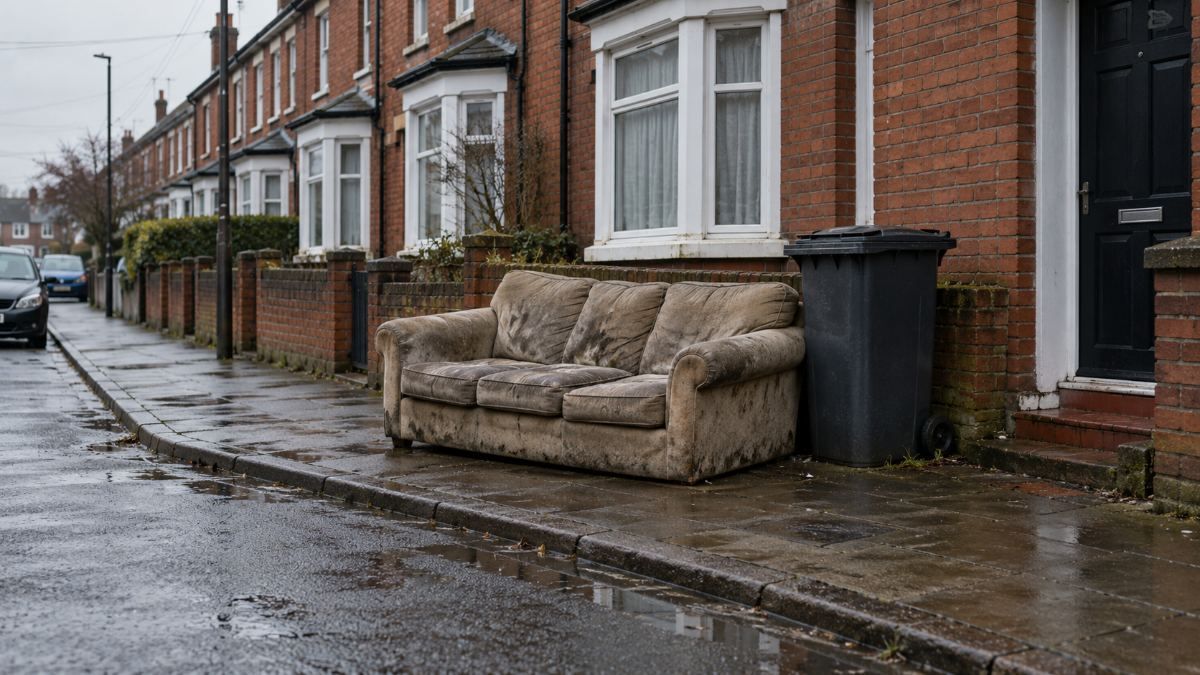
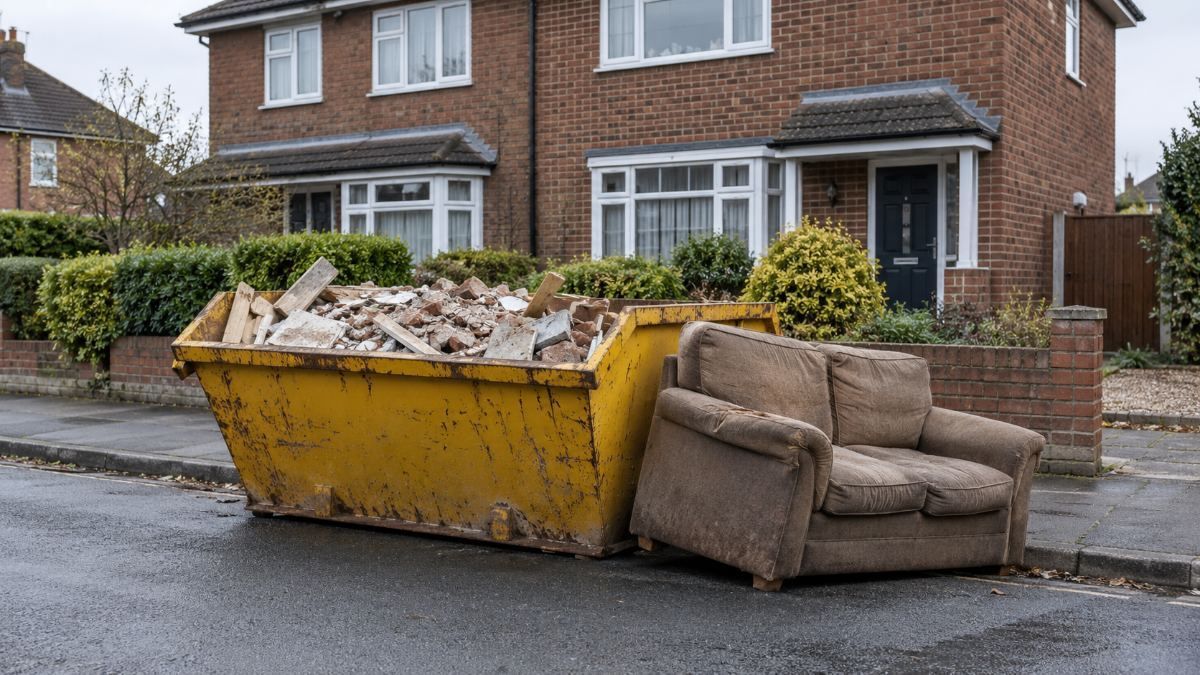
Do not leave the sofa in the communal hallway, the bin store or on the pavement outside while you work out the next step. Shared areas are escape routes, and most building managers will treat a sofa left there as fly-tipping. In the UK, fly-tipping is a criminal offence, and the sofa remains your responsibility until a licensed carrier or the council has taken it. Arrange the collection first, then move the sofa out to meet it.
When to leave it to a two-person crew
If the sofa is heavy, the stairwell is tight, the lift is small or the measurements leave no margin, book a crew rather than risking your back and the building. Our crews come in pairs with a van, carry the sofa out from wherever it sits in the flat, dismantle it in the room if that is what it takes, and load it. You open the door and that is all you need to do.
To get a price, email a photo of the sofa and say which floor it is on and whether there is a lift. We reply with one fixed price for the whole job, nothing is added on the day, and we aim for same-day or next-day collection wherever possible. If you want to understand what goes into that figure, read what affects sofa removal cost.
Questions people ask
Can a sofa go in a lift?
Often, if it stands on its end and the diagonal inside the lift is long enough. Measure the door opening and the inside of the lift first, and check with the building manager about protecting it or agreeing a time.
Should I take the legs off before moving a sofa?
Yes, nearly always. Legs add height, catch on door frames and are easy to snap on stairs. Most screw off in a minute. Keep the fixings in a bag taped to the frame.
What if the sofa will not fit down the stairs at all?
Then it has to be dismantled in the flat. Unbolt anything that unbolts and, if the frame is glued and stapled, cut it into sections that will go through the door. Our crew does this as part of the collection when it is needed.
Can I leave the sofa in the communal hallway for collection?
It is best not to. Shared hallways are escape routes, and a sofa left there can be treated as fly-tipping by the building manager or the council. Keep it in the flat until the crew arrives and we will carry it out from there.
Ready to get rid of it?
Fill in the form, attach a photo of the sofa to the email it opens, and we reply with a fixed price for collecting it from inside your home.
- Licensed waste carrier
- Fixed price from a photo
- Two-person crew and van
- Same or next day where possible

Get a fixed price from a photo
Fill this in and we open an email with your details ready. Attach a photo of the sofa and send.
Nearly there. Tap the button to open an email to us with your details filled in, attach a photo of the sofa and send it. You will get a fixed price back.
No email app on this device? Send the photo to hello@sofa-removal.co.uk with your postcode.